Performance, Prosperity, and the Body-Mind Connection
In high-performance environments, conversations around money, success, and growth often focus on strategy, skill, and execution. Yet many entrepreneurs, leaders, and professionals notice a quieter pattern beneath the surface – despite competence and effort, progress can sometimes feel harder than it should.
Increasingly, leadership psychology and mind–body research suggest that internal stress patterns – emotional, mental, and physiological – play a subtle but meaningful role in confidence, decision-making, and financial momentum.

Abundance, whether measured through revenue, opportunity, or long-term stability, rarely appears overnight. It tends to build gradually through small shifts in clarity, resilience, and self-trust. These shifts may show up in unexpected ways: a calmer response to financial pressure, improved focus during negotiations, or a steadier sense of certainty amid uncertainty.
From this perspective, money is not just a number; it often reflects how individuals relate to pressure, value, and possibility. By becoming aware of where stress is held in the body and how habitual thought patterns reinforce it, professionals can create space for more grounded, confident action.
This framework is not about belief or blind optimism. It is about self-awareness and reflection- using internal alignment to support sustainable performance and prosperity.
Abundance & Performance: A Practical Perspective
In today’s fast-paced corporate environment, success is no longer just about effort and strategy. Entrepreneurs, leaders, and high performers often notice that internal clarity plays a quiet but critical role in financial momentum and decision-making.

When internal stress remains unaddressed, it can subtly influence confidence, focus, and risk tolerance. When alignment improves, progress often feels more natural and sustainable.
How Money Interacts With Performance
Money itself is neutral. Its impact depends on how individuals relate to pressure, value, and responsibility.
When the relationship is healthy:
- Clearer financial decisions
- Reduced stress response
- Greater confidence under pressure
- Long-term thinking improves
When the relationship is strained:
- Overthinking or avoidance
- Fear-driven choices
- Burnout cycles
- Inconsistent results
A Simple Framework: Money & Internal Alignment
You can think of financial flow as moving through three internal layers:
- Awareness
- Noticing stress patterns
- Recognizing emotional triggers around money
- Regulation
- Calming the nervous system
- Creating mental and physical steadiness
- Action
- Making grounded financial decisions
- Responding rather than reacting
(Visual: simple 3-step flow diagram)
What Wealth Really Means (Today)
Wealth is not only accumulation. For many professionals, it reflects:
- Stability under pressure
- Trust in one’s decisions
- Capacity to adapt to uncertainty
- Freedom to choose intentionally
Clarifying What You Want (Quick Self-Check)
Instead of vague goals, clarity works better. Ask yourself:
- What result matters now?
- What would reduce stress immediately?
- What outcome supports both performance and well-being?
Examples:
- Increase income while reducing hours
- Stabilize cash flow within a set timeframe
- Feel more confident managing money
- Create space for growth without burnout
Clarifying Priorities: A Simple Reset
Shifting beliefs takes time. The key is to stay focused, realistic, and as uncomplicated as possible. Creating space to pause – away from constant noise and pressure – often makes it easier to reconnect with what genuinely matters.
At any given moment, there may be several things you want. Rather than chasing everything at once, clarity comes from choosing one primary focus. Ask yourself:
- What kind of bounce-back – or leap forward – do I want right now?
- What is number one on my list?
Common Priority Areas (Quick Self-Check)
Career & Work
- I want to restart my business
- I want to change my job and do something I really enjoy
- I want to work less and earn more
- I want to work less and keep a great standard of living
Financial Stability
- I want to clear my debts within 6 months
- I want to feel good about wanting/receiving money
- I want to have £X amount in my bank account by this time next year
Time & Lifestyle
- I want more time for myself and not have to work so much
- I want to walk the Camino
Personal Growth & Purpose
- I want to be an actress / doctor / reflexologist / EEM practitioner
Relationships & Emotional Well-being
- I want to leave this destructive relationship
- I want to mend my broken heart
- I want a loving relationship—on or before [choose a realistic date]
- I want to feel safe, loved, and cared for
Assets & Practical Goals
- I want to sell my house
- I want a new car
Clarity doesn’t require perfect answers – just honest ones. Choosing a single priority creates focus, reduces internal conflict, and sets the foundation for more intentional decisions moving forward.
Simplifying What You Want
Desires can be wide-ranging – experiences, lifestyle, health, creativity, freedom. The key is not to overthink them, but to keep each intention simple, focused, and clear.
When goals become complicated or over-analysed, clarity reduces and momentum slows. Most aspirations, when stripped back, relate to having enough financial stability, time, and energy to act on them.
Stress from everyday demands can make it difficult to articulate what we truly want. Creating a pause – through stillness, breath, or reflection – helps reduce mental noise and reconnect with inner clarity.
Body Awareness: Creating Mental Space
A calm body supports a clear mind. Slow breathing sends a signal of safety to the nervous system, helping thoughts settle and perspective return.
Heart Point: “The Genie in Your Hand” (Heart 8)
This point, located in the centre of the palm where the little finger naturally rests when the hand is closed, is traditionally associated with clarity and intention. Gently massaging this point while reflecting on a single priority can support focus and decision-making.
- Reflection statement: “I allow clarity to guide my next steps.”

Supporting Balance & Decision-Making
When balance is disrupted, emotional processing can feel heavier. Grounded routines, physical awareness, and intentional pauses help restore steadiness and resilience. Maintaining internal balance supports clearer planning, calmer responses, and more confident forward movement – especially during periods of change or pressure.
Reflection Statement:
“I make steady, well-considered financial decisions, even under pressure.”
Clarity & Decision-Making Points
Gallbladder 1 (GB1) This point supports clarity, vision, and discernment – especially during times of confusion or overwhelm. It helps bring a clearer perspective when decisions feel chaotic.
- Location: Just outside the outer edge of the eye. Many people instinctively touch this area when thinking hard or feeling mentally stuck.
- Reflection statement: “I see clearly and make confident decisions.”
Gallbladder 14 (GB14) A helpful point when you feel caught in indecision or mental overload.
- Location: One thumb-width above the centre of each eyebrow.
- Reflection statement: “I trust my judgment and move forward with ease.”
Releasing Stress & Creating Direction
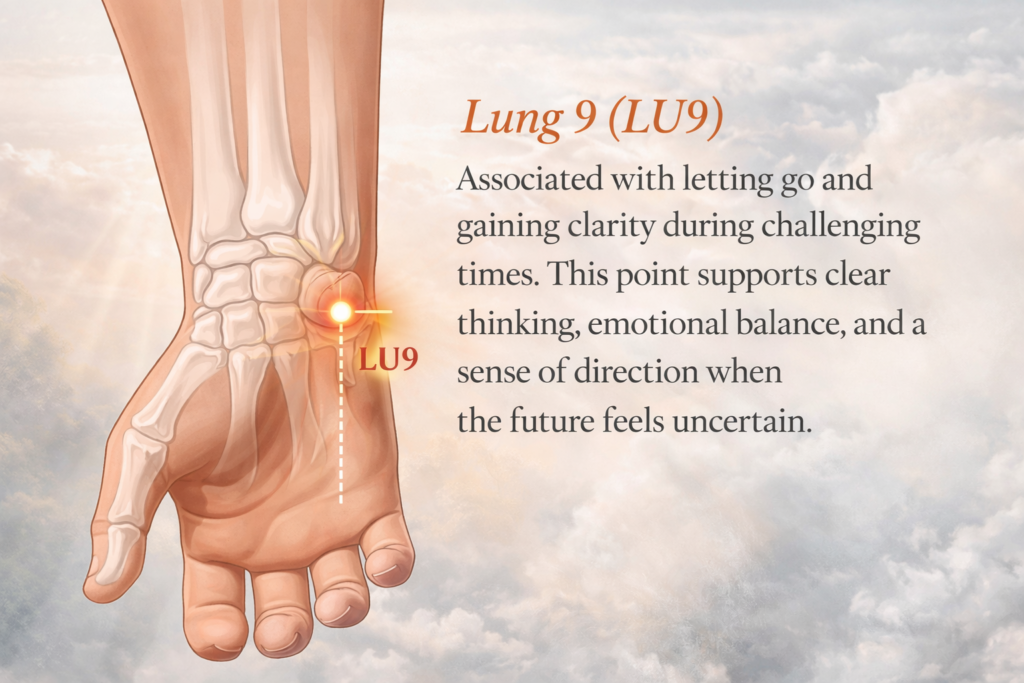
Lung 9 (LU9) Associated with letting go and gaining clarity during challenging times. This point supports clear thinking, emotional balance, and a sense of direction when the future feels uncertain.
- Reflection statement: “I release what no longer serves me and focus on what’s unfolding.”
Restoring Balance & Resilience
Bladder 66 (BL66) Supports renewal when energy feels depleted. Encourages rest, recovery, and steady momentum.
- Location: Base of the little toe on both feet.
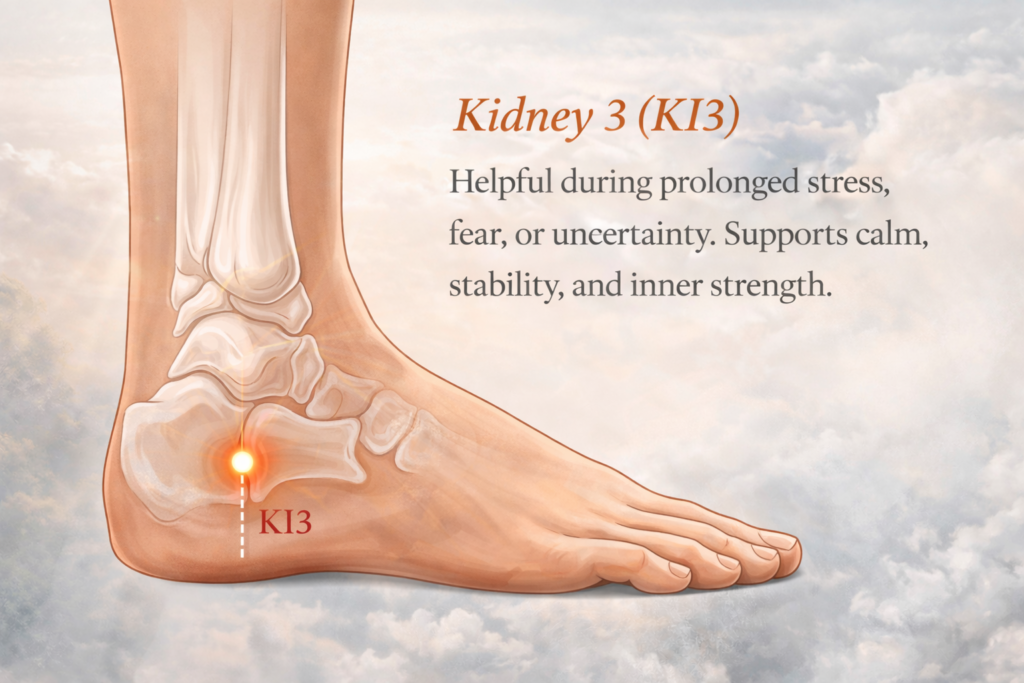
Kidney 3 (KI3) Helpful during prolonged stress, fear, or uncertainty. Supports calm, stability, and inner strength.
- Location: Inner ankle, just behind the ankle bone.
- Reflection statement: “I feel steady, supported, and resilient.”
Centre & Communication
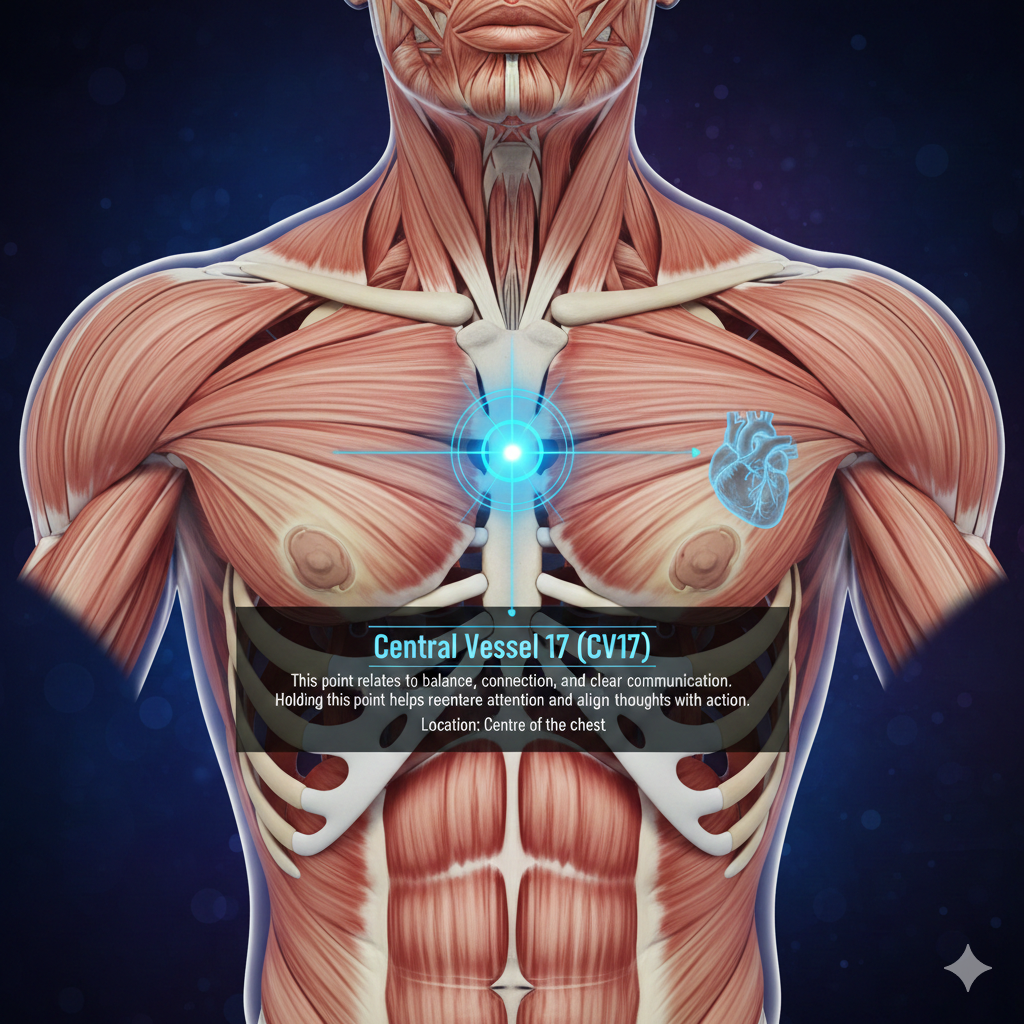
Central Vessel 17 (CV17) This point relates to balance, connection, and clear communication. Holding this point helps recentre attention and align thoughts with action.
- Location: Centre of the chest.
- Reflection statement: “I am clear, centred, secure, and confident in moving toward what I want.”
Money & Belief Awareness
Money itself is neutral. What matters is the meaning we assign to it – often shaped by family, culture, and experience.
Self-check: Say the statement aloud: “Money is a good, positive thing.”
- If it feels natural, reinforce the belief.
- If it feels uncomfortable, it may point to an underlying belief worth examining.
Awareness is the first step toward change.
Testing Your Core Belief About Money
Fact: If you don’t believe money is a positive thing, you may unconsciously push it away.
Say this statement aloud: “Money is a good, positive thing.” Pause and notice your response.
If it feels natural or strong:
- You’re less likely to hold a negative belief about money
- It’s still useful to reinforce this belief regularly
If it feels uncomfortable or weak:
- There may be an underlying belief that needs attention
- This belief can quietly influence financial choices and outcomes
Money is not about greed. It reflects how we engage with life, contribution, sharing, and growth. It is about flow, not hoarding. Money does not remove life’s challenges or lessons. However, in many situations, how we relate to money is a choice – and that choice shapes our experience.
If the statement felt weak, it suggests a broader tension around money. The next step is to look more closely at where that tension shows up internally. Even if the statement felt strong, continuing with deeper self-checks can help ensure no hidden patterns are working against you.
Creating Safety Around Money
For sustainable change, the mind needs to feel safe around the idea of money, wealth, and success. When safety increases, resistance reduces. One effective way to do this is through simple affirmations combined with physical cues that reinforce calm and confidence.
How to Practice
- State your intention clearly. Say your chosen statement aloud, for example: “It is now safe for me to be wealthy. All is well.” Or: “It is now safe for me to work less and earn more. All is well.”
- Add a physical anchor. Smile gently (this supports a positive emotional response), place one hand over your heart, and take a slow, steady breath.
This combination helps the body associate the statement with calm and reassurance.
Consistency Matters
- Practice at least twice a day.
- Short, regular repetition is more effective than occasional effort.
- If resistance shows up, that’s normal – change often takes time.
- You can also repeat the statement silently during everyday moments – while waiting in line, walking, or pausing between tasks. Writing it down reinforces the message further.
Visual Reinforcement
Once the statement feels comfortable, add a brief visual exercise:
- Imagine yourself achieving your goal.
- Notice how it looks, feels, and what changes around you.
- Mentally acknowledge it with a clear internal “yes.”
- Take a deep breath and return to the present moment.
This step supports confidence and forward focus.
Trust Internal Signals
Avoid undoing progress with overanalysis. Intuition often shows up quietly – as a sense of “this feels right.” Acting on these signals builds momentum and self-trust. Clarity grows when intention, body awareness, and action align.
One Final Exercise: Write this down. Keep it visible – at your desk, in your wallet, or where you’ll see it regularly. Repeat it often:
“I have a positive relationship with money. Money flows in with ease and balance.”
Practical Prosperity Tips
(Simple habits that reinforce clarity, flow, and consistency)
- Define with absolute clarity what you want and need right now.
- Reduce clutter in your workspace, home, car, and schedule – clarity improves focus.
- Take a short walk daily (15–20 minutes) to reset your thinking and perspective.
- Revisit your strategy regularly and take one small action each day toward your goal.
- Practice constructive self-talk – language shapes behaviour.
- Keep your environment orderly; small habits reinforce a sense of control and flow.
- Water is often used as a symbol of flow – ensure your physical and personal systems aren’t “leaking” energy unnecessarily.
- Take care of your body – rest, hydration, and recovery support resilience and optimism.
- Choose quality items you use daily that reflect self-respect and intention.
- Keep a meaningful reminder of your financial goal where you’ll see it often.
- Carry an object that symbolises confidence or growth—use it as a mental anchor.
- Use simple visual cues that remind you to be intentional with spending.
- Track money mindfully to avoid unconscious waste.
- Set a clear financial intention for the year and place it somewhere visible.
- Avoid empty spaces – keep your wallet and accounts active and organised.
- Accept support and generosity with grace; it reinforces healthy exchange.
- Invest time in work you genuinely enjoy – engagement improves results.
- Keep tools and cleaning items out of sight to reduce subconscious distraction.
- Create a small “focus corner” at home or work that represents growth and stability.
- Give back when possible – contribution reinforces flow.
- Avoid over-questioning every step; clarity often emerges through action.
- Spend time with people who are positive, grounded, and growth-oriented.
- Use symbols of calm or focus in your environment to reinforce intention.
- Write your primary affirmation and place it where you’ll see it daily.
- Use meaningful objects as reminders of progress and opportunity.
- Position symbolic items intentionally – trust what feels right to you.
- To align your workspace or home direction with your personal profile, connect with me to identify your Kua number and optimal positioning.
Acknowledgement
With gratitude to Madison King, whose original work and insights served as an important source of inspiration for the development of this framework. With appreciation to Donna Eden for sharing the beauty, wisdom, and intelligence of the human body through her pioneering work, which has inspired deeper awareness of the body – mind connection.


Being well-dressed is crucial for personal expression.
It helps show personal style and look polished.
A coordinated look affects social perception.
In daily life, clothing can add confidence.
Stylish outfits support professional encounters. t is important to consider unique style and suitability for the occasion.